
Under the Central Goods and Services Tax (CGST) Act, the department has the power to recover dues from a defaulter. However, the law is clear: they can only attach assets that belong to the person who owes the tax. Since you are the owner and the tenant is merely a “permissive occupier,” your bricks and mortar are generally off-limits.
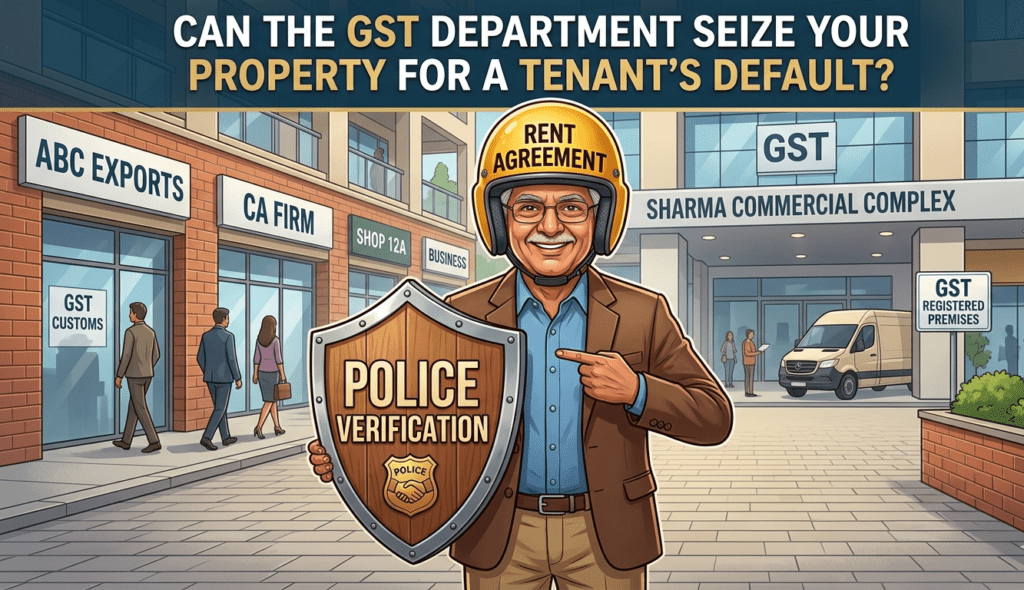
1. The “Paperwork Armor”: Your Rent Agreement
If the GST department comes knocking, the first thing they will look at is your Rent Agreement. If your agreement is casual or oral, you are inviting trouble.
- Stamp Duty Matters: In many states, for commercial properties, executing the agreement on a specific stamp paper (such as ₹1400 in certain regions) is not just a formality; it makes the document legally admissible.
- The Termination Clause: Your agreement must state that the tenant is required to cancel their GST registration at your address before vacating. If they leave without doing this, your property remains a “ghost office” on government records, making it hard to rent out to the next person.
2. The “Rent Trap” (Garnishee Orders)
While the department can’t take your building, they can take your rent. Under Section 79 of the CGST Act, if your tenant is a defaulter, the government can issue a notice directing you to pay the monthly rent directly to the Government Treasury instead of the tenant.
Human Touch Tip: If you get such a notice, don’t ignore it! Consult your CA immediately. Paying the tenant after receiving a government notice can make you legally liable for the tenant’s debt.
3. Local Body & Municipality Compliance
Many owners forget that doing business involves more than just GST. Ensure your tenant has the required Shop & Establishment license or local municipality registration.
- Ensure the Property Tax is cleared (usually the owner’s duty).
- Verify that the tenant is utilizing the land only for the purpose mentioned in the deed.
4. The “Police Verification” Shield
As a practical guide, always register your tenant with the local police station. This creates a formal record of “who is staying where.” If a tenant vanishes after a tax fraud, having that police verification receipt is your “Get Out of Jail Free” card, proving you did your due diligence as a law-abiding citizen.
5 Practical Steps for Every Landlord
- Define the Business: Explicitly mention in the deed what business is being conducted (e.g., “Software Consulting” or “Garment Export”).
- GST Status Checks: Ask for a copy of their GSTR-3B filing every quarter. If they aren’t filing, they are a risk to your peace of mind.
- Address Cleanup: Make sure the tenant adds your property as an “Additional Place of Business” (APOB) on the GST portal correctly.
- Deposit Retention: Include a clause that the security deposit will only be returned once the tenant provides proof of GST registration cancellation or address change.
- No Sub-Letting: Strictly prohibit the tenant from letting other “fly-by-night” businesses use your address for registration.
5 Frequently Asked Questions (FAQs)
Q1: Can the GST department seal my property? They can seal the premises temporarily if the tenant’s movable goods (stock, machinery) are inside and need to be seized. However, they cannot keep it locked indefinitely. Courts usually order the department to move the goods so the owner can regain possession.
Q2: What if the tenant disappears without paying GST? The department will look for the tenant’s assets. Since the building is yours, they cannot sell it. You will need to show your registered Rent Agreement and Police Verification to prove you were only the landlord.
Q3: Is a ₹100 stamp paper enough for a commercial lease? Usually, no. Commercial leases often require higher stamp duty based on the rent amount and duration. Using the wrong stamp paper can lead to penalties and make the agreement “junk” in the eyes of the law.
Q4: Does the landlord have to pay the tenant’s GST? Absolutely not. The tax liability is on the person who has the GSTIN (the tenant). You are only responsible for taxes on the rent you receive (if you are above the GST threshold).
Q5: How do I remove a tenant’s GST registration from my address after they leave? If the tenant doesn’t do it, you can write a formal letter to the Jurisdictional GST Officer with proof of the lease termination and request them to “suo-moto” cancel or move the registration.
Note: Consult your advisor/lawyer/CA for your specific case as this is general guidance to avoid problems as owner. Sole purpose to educate readers.