
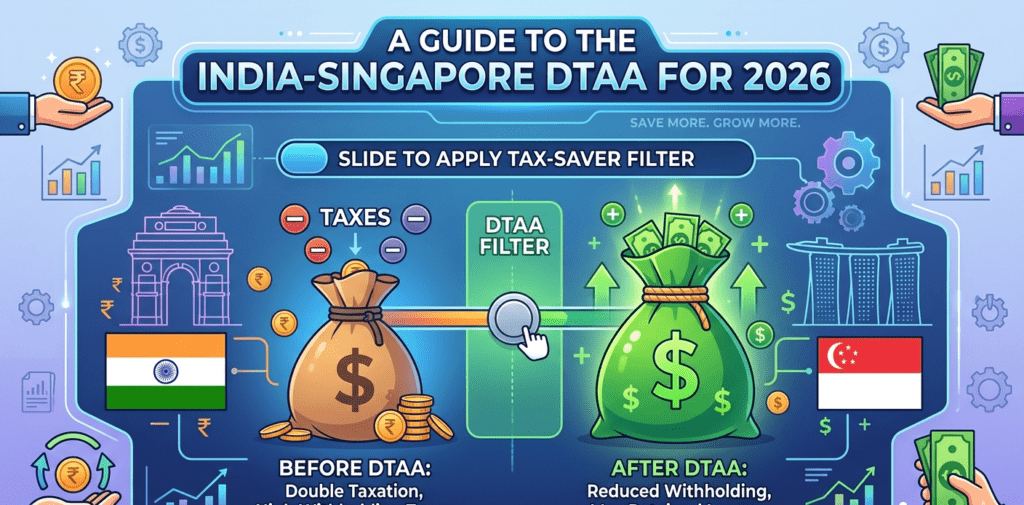
For many Indian NRIs in Singapore and residents back home with investments in the Singapore, the taxman can sometimes feel like a double-dipper. You earn in one place, but both governments want a slice of the pie.
Enter the Double Taxation Avoidance Agreement (DTAA)—the financial equivalent of a “no-double-parking” rule for your income. As we move through 2026, understanding this treaty is more than just good practice; it’s essential for protecting your global wealth.
What Exactly is a DTAA?
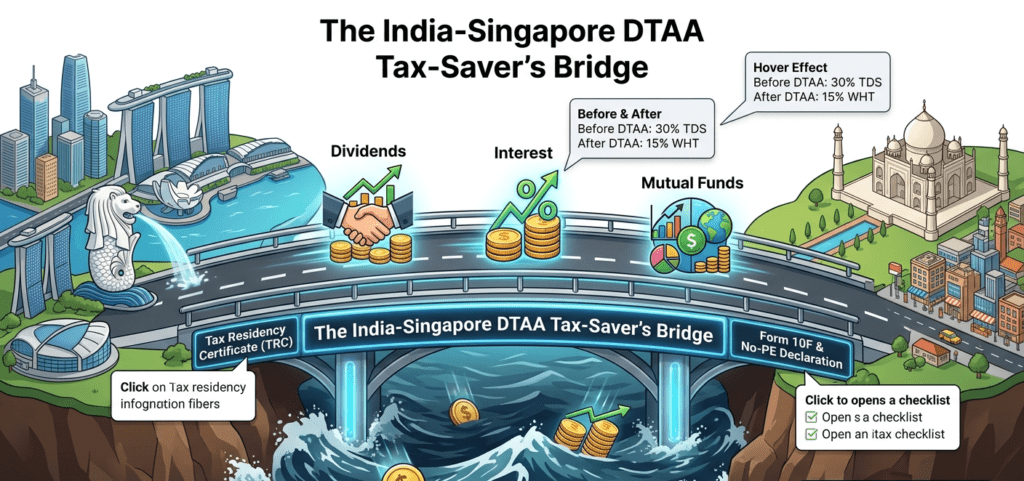
At its heart, a DTAA is a bilateral handshake between two countries (in this case, India and Singapore) to ensure that a taxpayer doesn’t pay tax on the same income twice.
Imagine you are an NRI in Singapore earning interest on an NRO account in India. Without a DTAA, India might tax that interest at 30%, and Singapore might want a share too. The DTAA steps in to say, “Wait, let’s decide who taxes what, and at what rate.”
Primary Objectives:
- Eliminating Double Taxation: Ensuring you only pay the “fair share” once.
- Promoting Investment: Making it cheaper for Singaporeans to invest in India and vice versa.
- Preventing Evasion: Sharing information to catch the “creative” bookkeepers.

Decoding the Jargon: Key Terms You Need to Know
Before we dive into the benefits, let’s clear up the “tax-speak.”
1. Resident
Your “tax home” isn’t always where your heart is; it’s where your calendar says you are.
- India: Generally, you’re a resident if you spend 182 days or more in India during a financial year.
- Singapore: You are typically a resident if you reside there for 183 days or more in a calendar year.
2. Permanent Establishment (PE)
This is a fancy term for a fixed place of business. If your Singaporean company has a dedicated office or a long-term project site in India, it might be considered a PE, meaning India gets to tax the profits specifically generated by that “branch.”
3. Source of Income
This determines where the money “was born.” Rental income from a condo in Orchard Road? That’s Singapore-sourced. Interest from a fixed deposit in Mumbai? That’s India-sourced.
4. Withholding Tax (WHT)
Think of this as “Tax Deducted at Source” (TDS). When a company pays you a dividend, they “withhold” a portion for the government before the money hits your account. DTAAs often lower these rates significantly.
Major Benefits for Indian NRIs in Singapore
If you are living in Singapore and have financial ties to India, the DTAA is your best friend. Here’s why:
1. The “Mutual Fund Goldmine”
Under the current interpretation of Article 13 of the treaty, capital gains on mutual funds and debt securities are often taxable only in the country of residence. Since Singapore generally does not levy capital gains tax on individuals, many NRIs can enjoy these gains virtually tax-free in both countries (provided they meet “Limitation of Benefits” or LoB clauses).
2. Slashed Withholding Rates
Without the DTAA, the Indian government might take a massive 30% bite out of your NRO account interest. Under the treaty:
- Interest Income: Capped at 15% (or even 10% for bank loans).
- Dividends: Capped at 15% (instead of the standard 20%+ domestic rate).
- Royalties/Technical Fees: Usually capped at 10%.
3. Grandfathered Capital Gains
While the treaty was amended in 2017 to allow India to tax gains on shares, any shares acquired before April 1, 2017, are “grandfathered”—meaning they may still be exempt from Indian capital gains tax when sold.
Benefits for Indian Residents (with Singapore Income)
Living in Bengaluru but earning from Singapore? You aren’t left out.
- Foreign Tax Credit (FTC): If you pay tax in Singapore on your earnings there, India allows you to claim a credit for that amount. You won’t pay the full Indian tax rate on top of what you already paid to the IRAS (Singapore’s tax authority).
- Business Profits: If you run a business in Singapore without a PE in India, your profits are generally only taxable in Singapore, which boasts a competitive corporate tax rate of 17%.
Real-World Scenarios
| Scenario | Without DTAA | With DTAA (Benefit) |
| NRI receives ₹1 Lakh dividend from India | ~₹20,000+ tax withheld | ₹15,000 tax (Saves ₹5,000+) |
| NRI sells Indian Equity Mutual Funds | 10% – 20% LTCG/STCG | 0% Tax in India (Residence-based) |
| Resident Indian earns rental in SG | Taxed in SG + Full Tax in India | Taxed in SG + Credit given in India |
How to Claim Your Benefits: The Paperwork
You can’t just “claim” it verbally; the tax authorities need receipts.
- Tax Residency Certificate (TRC): This is the “Golden Ticket.” You must obtain this from the IRAS in Singapore to prove you are a resident there.
- Form 10F: A self-declaration required by the Indian Income Tax Department. As of 2026, this must be filed electronically on the official portal.
- No-PE Declaration: A simple statement confirming you don’t have a Permanent Establishment in India.
- PAN Card: Essential for all Indian financial transactions to ensure the lower TDS rate is applied correctly.
Note for 2026: With the new Income Tax Act rolling out in April 2026, ensure your e-filing portal profile is updated, as compliance frameworks are becoming more streamlined but also more strictly monitored.
Conclusion
The India-Singapore DTAA is a powerful tool for anyone living a cross-border life. It prevents the “tax-on-tax” trap and makes Indian markets highly attractive for Singapore-based NRIs. However, tax laws are like Singapore’s weather—mostly predictable, but prone to sudden changes. Always consult with a qualified tax professional to ensure you meet the specific “Limitation of Benefits” criteria.
For more update stay tuned on www.taxbabuji.com. Read more blog on this topic.
Note : This note treated as professional advise consult your tax advisor before any act based on this content. This is only for education purpose.