
Discover the top 10 GST accounting software’s in India for 2026. This in-depth guide provides a comprehensive comparison, pricing details, and key features to help you choose the best solution for your business, ensuring seamless GST compliance and efficient financial management.
The Goods and Services Tax (GST) regime, implemented in India in 2017, revolutionized the indirect tax structure, aiming for a unified and simplified taxation system. While it brought numerous benefits, it also introduced complexities, particularly for businesses grappling with compliance requirements, invoice generation, return filing, and accurate record-keeping. To navigate this intricate landscape effectively, businesses of all sizes have increasingly turned to specialized GST accounting software.
These powerful tools streamline various financial processes, automate compliance tasks, reduce errors, and provide real-time insights into a company’s financial health. Choosing the right software, however, can be a daunting task given the plethora of options available in the Indian market. This comprehensive guide aims to simplify that decision by providing an in-depth comparison of the top 10 GST accounting softwares in India for 2024, complete with features, pros, cons, and pricing details.
The Importance of Robust GST Accounting Software
Before diving into the specifics of each software, let’s understand why investing in a good GST accounting solution is crucial for your business:
- Seamless GST Compliance: Automated calculation of GST, accurate invoice generation, and easy filing of various GST returns (GSTR-1, GSTR-3B, GSTR-9, etc.) ensure you stay compliant and avoid penalties.
- Reduced Errors: Manual data entry is prone to human errors, leading to discrepancies in financial records and GST filings. Software significantly minimizes these errors.
- Time and Cost Savings: Automating repetitive tasks frees up valuable time for you and your team, which can be reallocated to core business activities. It also reduces the need for extensive manual labor.
- Improved Efficiency: From invoicing and expense tracking to inventory management and bank reconciliation, integrated software enhances overall operational efficiency.
- Real-time Financial Insights: Dashboards and reporting features provide a clear, up-to-date picture of your business’s financial performance, aiding in better decision-making.
- Enhanced Audit Readiness: Organized and accurate records maintained by the software make audits smoother and less stressful.
- Better Inventory Management: Many GST accounting softwares come with integrated inventory management modules, helping businesses track stock levels, manage warehouses, and optimize procurement.
Understanding Your Business Needs Before Choosing
Before you explore the options, consider these critical factors:
- Business Size and Type: Are you a small startup, an SME, or a large enterprise? Do you deal in services or products? Do you have multiple branches?
- Budget: What is your allocated budget for accounting software?
- Features Required: Do you need basic invoicing and GST filing, or advanced features like payroll, CRM integration, multi-currency support, or extensive reporting?
- Ease of Use: Is the software user-friendly, especially for non-accounting professionals?
- Scalability: Can the software grow with your business?
- Support: What kind of customer support is offered (phone, email, chat, local partners)?
- Deployment: Do you prefer cloud-based (SaaS) or on-premise solutions?
Top 10 GST Accounting Softwares in India (2026)
Here’s a detailed look at the leading GST accounting softwares in the Indian market:
1. TallyPrime
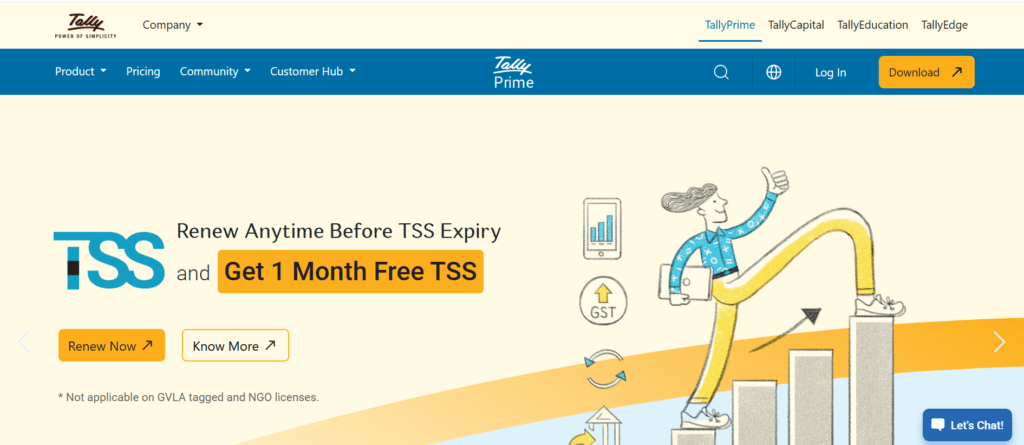
Overview: TallyPrime is arguably the most recognized and widely used accounting software in India. Building upon the legacy of Tally.ERP 9, TallyPrime offers enhanced usability, improved navigation, and a modern interface while retaining the robust accounting and GST compliance features that Tally is known for. It caters to businesses of all sizes, from small shops to large corporations.
Key Features:
- Comprehensive Accounting: General ledger, accounts payable/receivable, cash/bank management.
- Robust GST Compliance: Automated GST invoice generation, e-invoicing, e-way bill generation, GSTR-1, GSTR-3B, GSTR-2A reconciliation, GSTR-9 filing.
- Inventory Management: Multi-location inventory, stock valuation, batch-wise tracking, manufacturing journal.
- Payroll Management: Employee management, attendance, salary processing, statutory compliance (PF, ESI, TDS).
- Reporting: Extensive financial, inventory, and management reports.
- Multi-currency Support: Manage transactions in multiple currencies.
- Data Security: Robust data backup and restore options.
- Remote Access: Tally’s “licence on demand” allows access from anywhere.
Pros:
- Industry Standard: Widely used and understood in India, making it easy to find skilled personnel.
- Feature-Rich: Covers almost every aspect of business management.
- Strong Support Network: Extensive network of partners and consultants across India.
- Reliability: Known for its stability and data integrity.
- Customizable: Can be customized to specific business needs through TDL (Tally Definition Language).
Cons:
- Steep Learning Curve: Can be complex for beginners without prior Tally experience.
- Interface: While improved with TallyPrime, some users still find it less intuitive than purely cloud-based solutions.
- Cost: Can be relatively expensive for very small businesses.
- On-premise Focus: Primarily an on-premise solution, though remote access features are available.
Pricing:
- Silver Edition (Single User): ₹18,000 + GST (perpetual license)
- Gold Edition (Multi-User): ₹54,000 + GST (perpetual license)
- Annual Tally Software Services (TSS) for updates and support: approximately 20% of the license cost.
Best For: SMEs and large businesses looking for a comprehensive, robust, and widely supported on-premise accounting solution with strong GST compliance.
2. Zoho Books
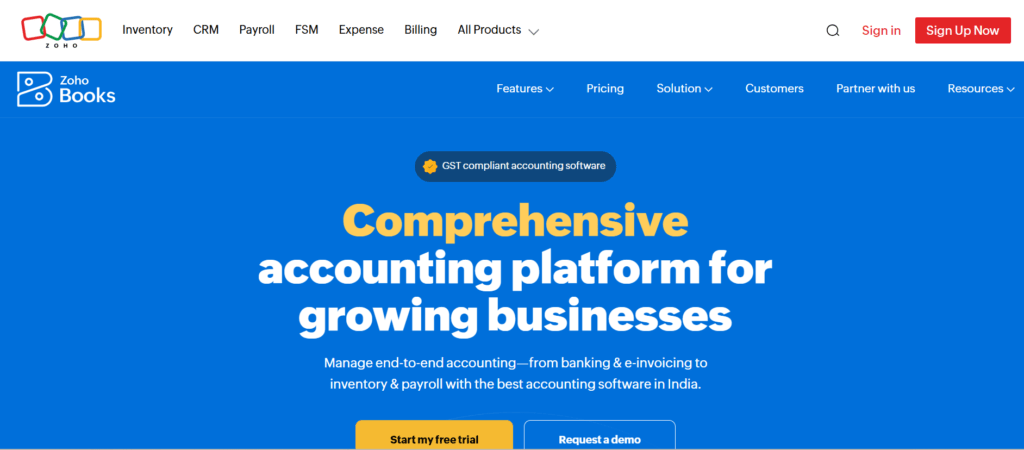
Overview: Zoho Books is a popular cloud-based accounting software designed for small to medium-sized businesses. Part of the larger Zoho ecosystem, it offers a clean interface, excellent automation capabilities, and seamless integration with other Zoho applications. Its focus on user-friendliness and accessibility makes it a strong contender for businesses adopting digital solutions.
Key Features:
- Online Invoicing: Professional invoices, recurring invoices, payment reminders.
- GST Compliance: Automated GST calculation, e-invoicing, e-way bills, direct filing of GSTR-1, GSTR-3B, GSTR-9.
- Expense Tracking: Record and categorize business expenses, attach receipts.
- Bank Reconciliation: Automatically fetch bank statements and reconcile transactions.
- Inventory Management: Track stock levels, manage items, create purchase orders.
- Time Tracking: Bill clients for time spent on projects.
- Project Management: Track project expenses and profitability.
- Reporting: Customizable reports for profit & loss, balance sheet, cash flow, etc.
- Mobile App: Manage finances on the go with dedicated Android and iOS apps.
Pros:
- Cloud-based: Accessible from anywhere, anytime.
- User-friendly Interface: Intuitive and easy to navigate, even for non-accountants.
- Automation: Automates invoicing, payment reminders, and bank feeds.
- Integrations: Seamlessly integrates with other Zoho apps (CRM, Payroll, Inventory) and third-party tools.
- Cost-effective: Multiple plans catering to different business sizes.
- Excellent Support: Known for responsive customer service.
Cons:
- Limited Customization: May not offer the deep customization options of Tally.
- Offline Access: Requires an internet connection for full functionality (though some offline capabilities exist for data entry).
- Feature Set for Large Enterprises: Might lack some advanced features required by very large, complex organizations.
Pricing (Annual Subscription):
- Free: For businesses with revenue under ₹50 lakhs.
- Standard: ₹2,499 per organization per year.
- Professional: ₹3,999 per organization per year.
- Premium: ₹7,999 per organization per year.
- Elite: ₹15,999 per organization per year (includes e-invoicing credits).
- Ultimate: ₹23,999 per organization per year. (Prices may vary; check Zoho Books website for the latest)
Best For: Small to medium-sized businesses, startups, freelancers, and service-based businesses looking for an affordable, intuitive, and feature-rich cloud accounting solution with strong GST compliance.
3. Busy Accounting Software
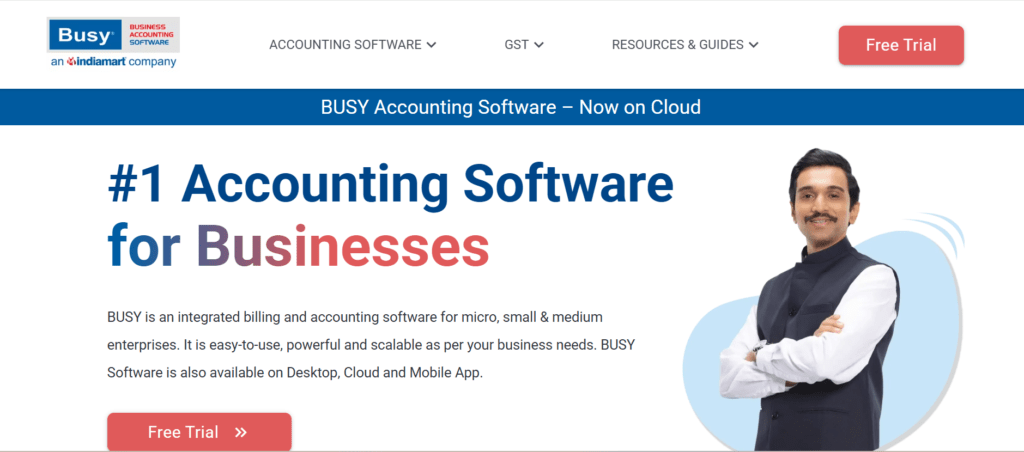
Overview: Busy is another well-established accounting software in India, particularly popular among small and medium enterprises (SMEs) and manufacturers. It offers a robust set of features, including comprehensive accounting, inventory management, and manufacturing capabilities, making it suitable for businesses with complex operational needs.
Key Features:
- Financial Accounting: Multi-currency, multi-location accounting, cost centers.
- GST Compliance: Detailed GST reporting, GSTR-1, GSTR-3B, GSTR-2A reconciliation, e-invoicing, e-way bill.
- Inventory Management: Multi-godown management, batch-wise inventory, item-wise taxation, production and bill of material (BOM).
- Payroll: Basic payroll functionalities.
- MIS Reports: Extensive management information system reports.
- CRM Integration: Basic customer relationship management features.
- POS (Point of Sale): Integrated POS module for retail businesses.
Pros:
- Strong Inventory & Manufacturing: Excellent for businesses with complex inventory and production processes.
- Comprehensive: Covers a wide range of business functions beyond basic accounting.
- Customizable Reports: Users can generate highly specific reports.
- Local Support: Good network of dealers and support providers.
- Scalable: Different editions cater to varying business sizes.
Cons:
- User Interface: Can appear dated compared to modern cloud solutions; less intuitive for new users.
- Learning Curve: Requires some effort to master all its features.
- Primarily On-Premise: Though cloud deployment options are emerging, its core strength lies in on-premise installation.
- Cost: Higher editions can be pricey.
Pricing (Perpetual License + Annual AMC):
- Basic Edition: Starting from ₹7,200 + GST
- Standard Edition: Starting from ₹13,500 + GST
- Enterprise Edition: Starting from ₹22,500 + GST (Annual Maintenance Contract (AMC) typically 20% of the license cost for updates and support.)
Best For: Small to medium-sized manufacturing businesses, distributors, and traders who require detailed inventory, production, and accounting features.
4. Marg ERP 9+
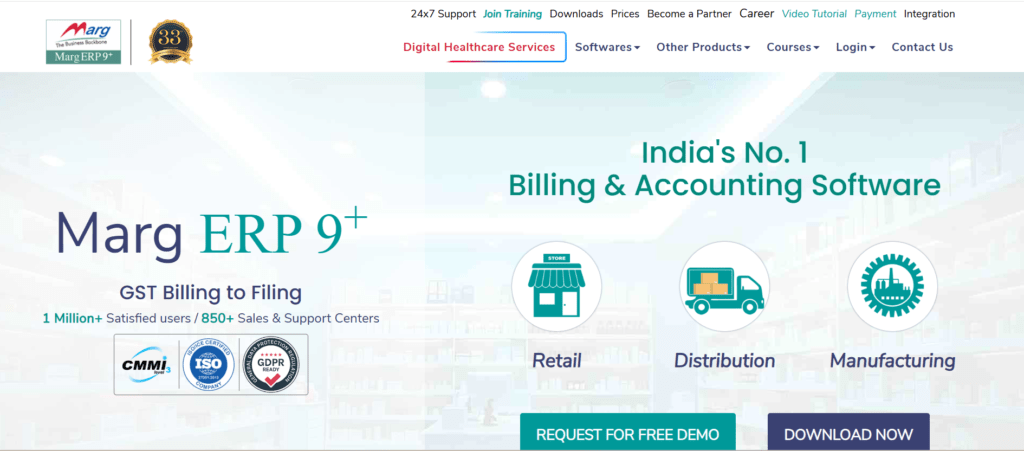
Overview: Marg ERP 9+ is a highly specialized ERP solution, especially renowned in the pharmaceutical, retail, and distribution sectors. It offers industry-specific solutions along with robust accounting, inventory, and GST compliance features. Marg focuses on providing tailored solutions that address the unique challenges of various business verticals.
Key Features:
- Industry-Specific Modules: Specialized solutions for pharma, FMCG, electronics, jewelry, etc.
- Comprehensive Inventory Management: Batch-wise tracking, expiry dates, reorder levels, multi-location, scheme management.
- GST Compliance: GST billing, e-invoicing, e-way bill, automatic return generation (GSTR-1, 3B, 9).
- Purchase & Sales Management: Order management, billing, quotations, scheme & discount management.
- Financial Accounting: Bank reconciliation, ledger management, trial balance.
- Reporting: Extensive range of analytical and statutory reports.
- Mobile App Integration: Manage sales and orders on the go.
Pros:
- Vertical-Specific Strength: Highly powerful for businesses in specific industries, particularly pharma and distribution.
- Advanced Inventory: Excellent for businesses with complex inventory needs like batch tracking and expiry dates.
- Strong Dealer Network: Wide presence and support across India.
- Customization: Can be customized to suit specific business workflows.
Cons:
- Complexity: Can be overwhelming for businesses outside its core target industries or those with simpler needs.
- Learning Curve: Requires significant training to utilize fully.
- Interface: Similar to Busy, the interface can feel less modern.
- Primarily On-Premise: Though cloud options are available, its strong suit is local deployment.
Pricing (Perpetual License + Annual AMC):
- Basic Edition: Starts around ₹8,100 + GST
- Silver Edition (Single User): Starts around ₹12,600 + GST
- Gold Edition (Multi-User): Starts around ₹22,500 + GST (Prices can vary significantly based on industry-specific modules and customizations. AMC is typically charged annually.)
Best For: Businesses in the pharmaceutical, retail, distribution, and manufacturing sectors that require highly specialized inventory, sales, and purchasing modules along with strong accounting.
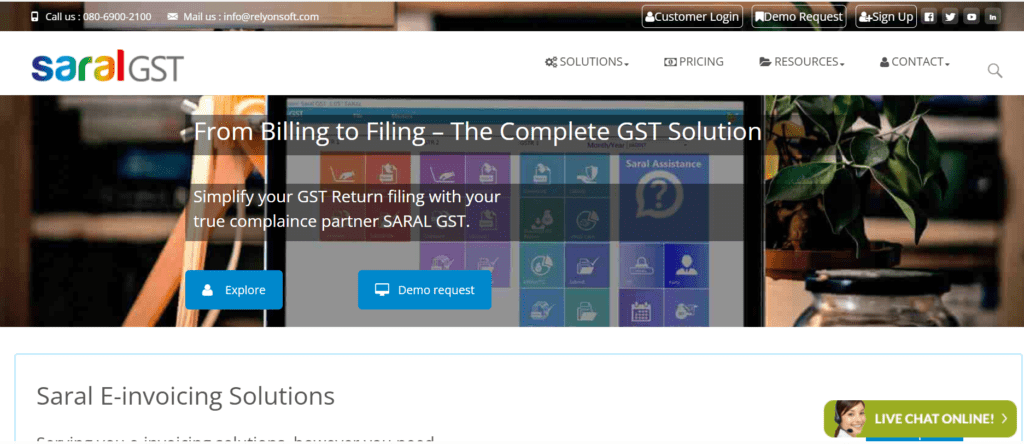
5. Saral GST
Overview: Saral GST, developed by Relyon Softech Ltd., is a dedicated GST compliance software known for its user-friendliness and accuracy in GST return filing. While it offers core accounting features, its primary strength lies in simplifying the complexities of GST, making it an excellent choice for businesses primarily focused on robust compliance.
Key Features:
- GST Return Filing: Direct filing of GSTR-1, GSTR-3B, GSTR-4, GSTR-9, GSTR-9C.
- Invoice Management: Create GST-compliant invoices.
- e-Way Bill Generation: Generate and manage e-way bills effortlessly.
- e-Invoicing: Comprehensive support for e-invoicing mandates.
- Input Tax Credit (ITC) Reconciliation: Powerful reconciliation tools for GSTR-2A/2B with purchase data.
- Data Import: Import data from Tally, Excel, and other accounting software.
- Reporting: Various GST-related reports and summaries.
Pros:
- Excellent for GST Compliance: Highly focused and efficient in handling all aspects of GST returns and reconciliation.
- User-friendly: Relatively easy to use and understand, especially for those new to GST software.
- Accurate Reconciliation: Robust tools for matching ITC.
- Data Import Capabilities: Flexible in integrating data from existing systems.
- Good Support: Relyon has a good reputation for customer support.
Cons:
- Limited Core Accounting: While it has some accounting features, it’s not a full-fledged ERP like Tally or Marg.
- No Inventory Management: Lacks comprehensive inventory and payroll modules.
- On-Premise: Primarily an desktop application.
Pricing:
- Saral GST (Standard): Starting from ₹4,500 + GST (annual license)
- Saral GST (Professional): Starting from ₹7,500 + GST (annual license with more users/features) (Check Relyon Softech website for latest pricing and editions.)
Best For: Businesses and tax professionals whose primary need is streamlined and accurate GST return filing, e-invoicing, and e-way bill generation, especially those who already use another software for core accounting.
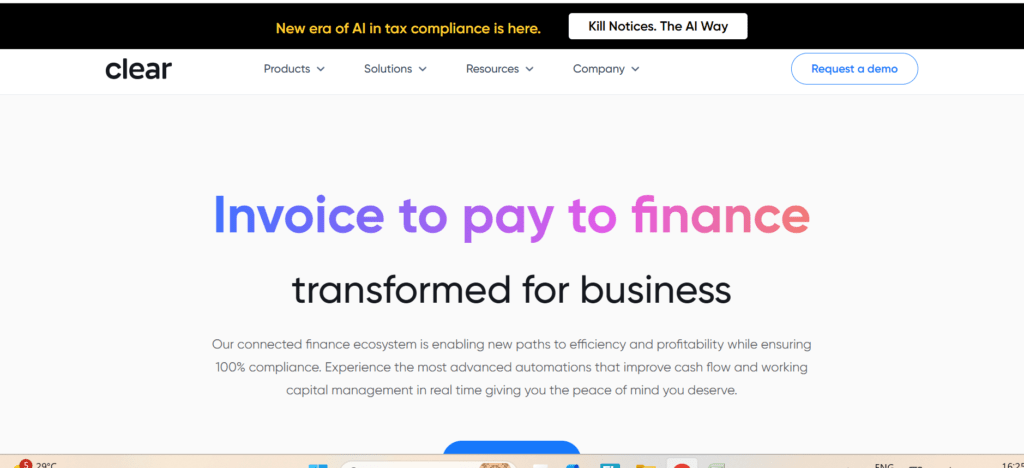
6. ClearTax GST
Overview: ClearTax, a well-known financial technology platform in India, offers a comprehensive cloud-based GST software solution. It’s particularly popular for its strong focus on simplified GST compliance, advanced reconciliation features, and user-friendly interface. ClearTax GST is designed to help businesses, accountants, and tax professionals manage GST efficiently.
Key Features:
- Automated GST Filing: Direct filing of GSTR-1, GSTR-3B, GSTR-4, GSTR-9, etc.
- Intelligent ITC Reconciliation: Powerful reconciliation engine to match GSTR-2A/2B with purchase data, identifying mismatches.
- e-Invoicing: Seamless generation, integration, and management of e-invoices.
- e-Way Bill: Generate and manage e-way bills with ease.
- Data Import: Import data from Tally, Excel, SAP, Oracle, and other ERPs.
- Smart Reports: Various GST compliance and analytical reports.
- Invoice Generation: Create GST-compliant sales and purchase invoices.
- Multi-GSTIN Support: Manage multiple GSTINs from a single dashboard.
Pros:
- Cloud-based: Accessible from anywhere with an internet connection.
- Excellent Reconciliation: Known for its highly effective and automated ITC reconciliation tool.
- User-friendly Interface: Modern and intuitive design.
- Robust Compliance Engine: Ensures accurate and timely GST filings.
- Data Security: High standards of data security.
- Integration Capabilities: Easily integrates with various accounting systems.
Cons:
- Not a Full-Fledged ERP: Primarily focused on GST compliance; lacks comprehensive core accounting and inventory modules.
- Pricing Structure: Can be subscription-based, which may not suit all budgets for long-term use compared to perpetual licenses.
- Reliance on Internet: Requires a stable internet connection.
Pricing:
- ClearTax GST offers various plans, typically based on the number of transactions or GSTINs.
- Annual Subscription: Plans can range from ₹10,000 to ₹50,000+ per year, depending on the features and scale. (Check ClearTax website for the most up-to-date pricing and customized solutions.)
Best For: Tax consultants, CAs, and businesses that need a robust, cloud-based solution primarily for efficient and accurate GST return filing, e-invoicing, e-way bill management, and critical ITC reconciliation, often alongside existing accounting software.
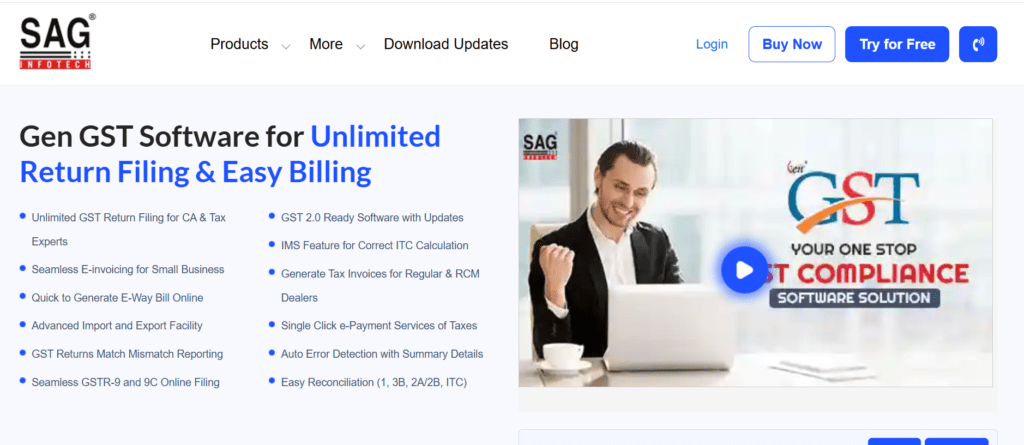
7. Gen GST
Overview: Gen GST is a comprehensive GST software suite developed by SAG Infotech, offering solutions for e-filing, e-invoicing, e-way bills, and various other GST compliance requirements. It’s available in both desktop and cloud versions, catering to a wide range of users from individual professionals to large enterprises.
Key Features:
- GST Return Filing: GSTR-1, GSTR-2A, GSTR-3B, GSTR-4, GSTR-5, GSTR-6, GSTR-7, GSTR-8, GSTR-9, GSTR-9C.
- e-Invoicing & e-Way Bill: Integrated generation and management.
- ITC Reconciliation: Match invoices and reconcile GSTR-2A/2B.
- Invoice Generation: Create GST-compliant invoices.
- Client Management: Manage multiple clients/GSTINs (useful for CAs).
- Data Import: Facilitates import from Excel, Tally.
- Reporting: Detailed reports for GST compliance.
- Desktop & Cloud Options: Flexibility in deployment.
Pros:
- Comprehensive Compliance: Covers almost all GST return types and compliance needs.
- Flexible Deployment: Offers both desktop (on-premise) and cloud versions.
- Good for Professionals: Designed with features useful for tax practitioners managing multiple clients.
- Affordable: Generally offers competitive pricing.
- User Support: Provides decent customer support.
Cons:
- User Interface: Can be less modern and intuitive than some purely cloud-native solutions.
- Not a Full Accounting System: Primarily focused on GST, not a comprehensive accounting or ERP solution.
- Learning Curve: Some users might find the initial setup and navigation a bit complex.
Pricing (Annual Subscription):
- Desktop Version: Starting from ₹5,000 to ₹15,000+ per year (single user/multi-user).
- Cloud Version: Similar range, often based on features and number of GSTINs. (Prices vary based on modules and user count.)
Best For: Tax professionals, chartered accountants, and businesses seeking a dedicated and comprehensive software for all their GST compliance and e-filing needs, with the flexibility of both desktop and cloud options.
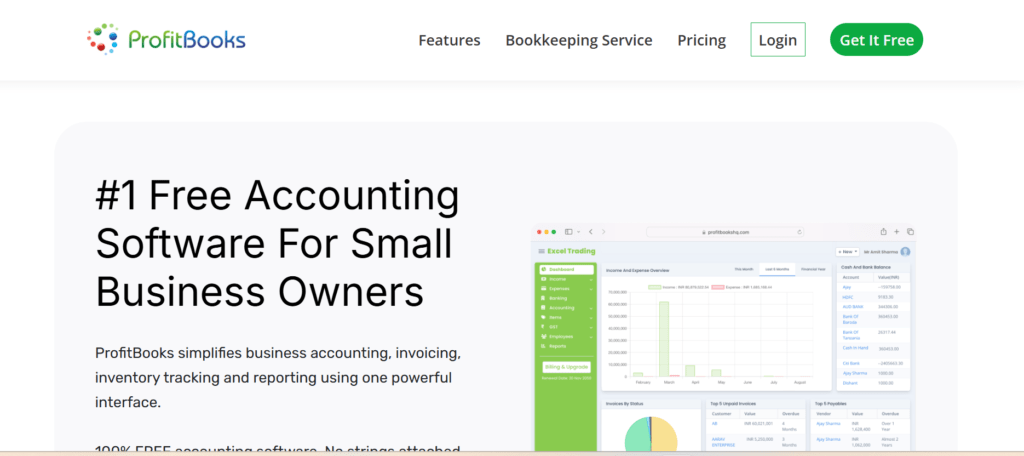
8. ProfitBooks
Overview: ProfitBooks is a popular cloud-based accounting software tailored for small and medium businesses in India. It focuses on simplicity and ease of use, making it an excellent choice for business owners who are not accounting experts. It combines core accounting with invoicing, inventory, and basic payroll features.
Key Features:
- GST Billing & Accounting: Create GST-compliant invoices, record expenses, manage ledgers.
- Inventory Management: Track stock, manage products, low stock alerts.
- e-Way Bill Generation: Directly generate e-way bills.
- Reporting: Profit & Loss, Balance Sheet, Cash Flow, GST reports.
- Bank Reconciliation: Connect bank accounts and reconcile transactions.
- Payroll: Basic payroll features (employee management, salary processing).
- Mobile App: Manage business on the go.
- Integrations: Connects with payment gateways, CRM, and other tools.
Pros:
- User-friendly: Very easy to learn and use, even for those without an accounting background.
- Cloud-based: Accessible anytime, anywhere.
- Affordable: Good value for money with a decent feature set.
- Good for Small Businesses: Perfectly suited for startups and growing SMEs.
- Responsive Support: Good customer service.
Cons:
- Limited Advanced Features: May not be robust enough for very complex accounting or large enterprises.
- No Direct GST Filing: While it generates GST reports, direct filing might require integration or manual upload to the GSTN portal.
- Scalability for Large Operations: Might require an upgrade to a more powerful ERP as a business scales significantly.
Pricing (Annual Subscription):
- Starter: ₹3,999 per year
- SMB: ₹7,999 per year
- Professional: ₹11,999 per year (Check ProfitBooks website for the latest pricing and features included in each plan.)
Best For: Small and medium businesses, freelancers, and startups looking for an intuitive, affordable, and cloud-based accounting solution that covers invoicing, basic inventory, and GST reporting.
9. Vyapar
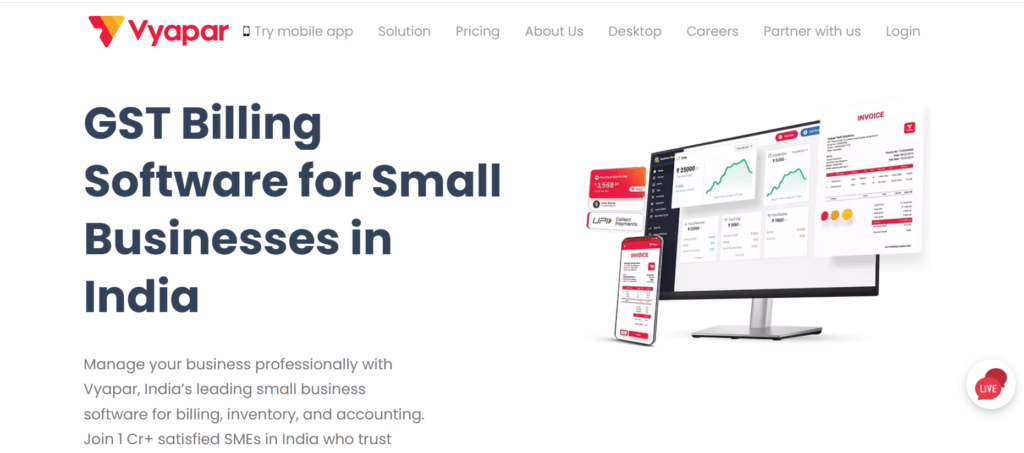
Overview: Vyapar is a free (for desktop) and affordable (for mobile) GST billing and accounting software designed specifically for small businesses, retailers, and self-employed individuals in India. Its main appeal lies in its simplicity, offline capabilities, and strong focus on invoicing and basic accounting.
Key Features:
- GST Billing & Invoicing: Create professional GST invoices, quotations, proforma invoices.
- Inventory Management: Track stock, manage items, set low stock alerts.
- Expense Tracking: Record business expenses.
- Bank & Cash Management: Manage cash flow, bank accounts.
- GST Reports: Generate various GST reports (GSTR-1, GSTR-3B).
- Offline Access: Works without an internet connection (desktop version).
- Mobile App: Comprehensive mobile app for Android.
- Barcode Scanner: Integrates with barcode scanners for quick billing.
Pros:
- Free Desktop Version: Highly attractive for very small businesses with tight budgets.
- User-friendly & Simple: Extremely easy to learn and operate.
- Offline Functionality: Crucial for businesses in areas with unreliable internet.
- Mobile-First Approach: Excellent mobile app for on-the-go management.
- Regional Language Support: Available in multiple Indian languages.
Cons:
- Limited Advanced Features: Lacks advanced ERP capabilities, complex reporting, or payroll.
- No Direct GST Filing: Primarily for generating GST reports; actual filing needs to be done manually or through other portals.
- Scalability: Might not be suitable for rapidly growing or larger SMEs.
- Basic Customer Support: Being a free/low-cost solution, support might not be as extensive.
Pricing:
- Desktop Version: Free (with some limitations, e.g., branding on invoices).
- Premium Desktop Features: Annual subscription, typically around ₹2,000 – ₹3,000 per year.
- Mobile App: Annual subscription, typically around ₹1,999 per year. (Prices are indicative and subject to change; check Vyapar website for the latest.)
Best For: Micro, small businesses, retailers, self-employed individuals, and freelancers who need a simple, cost-effective (or free) solution primarily for GST billing, basic accounting, and inventory, especially those who prefer offline access or mobile management.
10. Logic ERP
Overview: Logic ERP is a comprehensive Enterprise Resource Planning (ERP) solution designed for medium to large enterprises, particularly strong in retail, distribution, and manufacturing sectors. While it’s a full-fledged ERP, its accounting and GST modules are robust and integral to its offering, providing an integrated approach to business management.
Key Features:
- Integrated ERP Modules: Financial accounting, inventory, sales & purchase, manufacturing, HR & payroll, CRM.
- Advanced Accounting: Multi-branch, multi-company, multi-currency support, budgeting, cost centers.
- Comprehensive GST Compliance: Automated GST calculation, e-invoicing, e-way bill, all GST return types, reconciliation.
- Powerful Inventory Management: Batch/serial tracking, warehouse management, demand forecasting, production planning.
- Reporting & Analytics: Customizable dashboards and extensive analytical reports.
- POS Integration: Robust POS for retail operations.
- Mobile App: For sales, order management, and reporting.
Pros:
- True ERP: Provides a fully integrated solution for all aspects of a business.
- Highly Scalable: Can handle complex operations of large enterprises.
- Industry-Specific Solutions: Offers tailored solutions for various sectors.
- Robust Functionality: Advanced features for every business function.
- Customization: Highly customizable to fit unique business processes.
Cons:
- Cost: Significant investment, making it unsuitable for small businesses.
- Complexity: Requires extensive implementation, training, and ongoing support.
- Learning Curve: Steep learning curve for users.
- Implementation Time: Can take considerable time to deploy and configure fully.
Pricing:
- Logic ERP’s pricing is typically custom-quoted based on the modules required, number of users, customization, and implementation services. It involves a substantial upfront cost for licenses and ongoing annual maintenance charges (AMCs).
- Expect costs to range from lakhs to tens of lakhs of rupees depending on the scale and complexity.
Best For: Medium to large enterprises, multi-location retail chains, distributors, and manufacturing companies that require a fully integrated, scalable ERP solution with robust accounting and GST compliance.
Conclusion: Choosing Your Ideal GST Accounting Software
The Indian market offers a diverse range of GST accounting software, each with its unique strengths and target audience. The “best” software isn’t a one-size-fits-all answer; it’s the one that most closely aligns with your specific business needs, budget, and operational complexities.
- For robust, traditional accounting with deep features, strong local support, and an on-premise preference: TallyPrime and Busy Accounting Software remain top choices.
- For modern, cloud-based solutions focusing on user-friendliness, automation, and affordability for SMEs: Zoho Books and ProfitBooks stand out.
- For businesses with highly specialized inventory and distribution needs (e.g., pharma, retail): Marg ERP 9+ offers industry-specific solutions.
- For dedicated GST compliance, e-invoicing, e-way bills, and advanced ITC reconciliation, often alongside existing accounting systems: ClearTax GST and Saral GST are excellent. Gen GST offers a flexible option here too.
- For micro-businesses, retailers, or freelancers needing a very simple, cost-effective (or free) billing and basic accounting solution: Vyapar is an ideal starting point.
- For large enterprises requiring a comprehensive, integrated ERP solution across all business functions: Logic ERP provides the necessary scale and depth.
Before making a final decision, we strongly recommend:
- Free Trials/Demos: Take advantage of free trials or request demos from your shortlisted software providers.
- Consult with Professionals: Discuss your requirements with your accountant or a tax professional.
- Read Reviews: Look for user reviews and testimonials.
- Evaluate Support: Check the quality and availability of customer support.
- Consider Scalability: Ensure the software can grow with your business.
By carefully evaluating these factors and exploring the detailed comparisons above, you can confidently select the GST accounting software that will empower your business to achieve seamless compliance, greater efficiency, and sustained growth in the dynamic Indian economic landscape.
Official Website Directory
- TallyPrime: https://tallysolutions.com
- Zoho Books: https://www.zoho.com/in/books/
- Busy Accounting: https://busy.in
- Marg ERP 9+: https://margerp.com
- Saral GST: https://www.saralgst.com
- Clear (formerly ClearTax): https://clear.in
- Gen GST: https://saginfotech.com/gengst.aspx
- ProfitBooks: https://www.profitbooks.net
- Vyapar: https://vyaparapp.in
- Logic ERP: https://logicerp.com
Stay tuned for more such topics on www.taxbabuji.com